Rethinking Consent for AI Apps
Rethinking Consent for AI Apps
Rethinking Consent for AI Apps
Role
Role
Role
UX Designer & Researcher
UX Designer & Researcher
UX Designer & Researcher
Timeline
Timeline
Timeline
2 Weeks
2 Weeks
Type
Type
Type
Personal Project
Personal Project
Personal Project
Tools
Tools
Tools
Figma
FigJam
Tally
Figma·FigJam·Tally
Figma·FigJam·Tally
Overview
Overview
Overview
Clarity is a privacy-first conversational AI for managing daily stress and anxiety. Rather than requesting broad permissions at onboarding, it introduces contextual consent by asking for data only at moments where value is immediately clear.
Clarity is a privacy-first conversational AI for managing daily stress and anxiety. Rather than requesting broad permissions at onboarding, it introduces contextual consent by asking for data only at moments where value is immediately clear.
Clarity is a privacy-first conversational AI for managing daily stress and anxiety. Rather than requesting broad permissions at onboarding, it introduces contextual consent by asking for data only at moments where value is immediately clear.
Design Question
Design Question
Design Question
How might we design AI consent so users feel informed, respected, and in control at the moment consent is requested?
How might we design AI consent so users feel informed, respected, and in control at the moment consent is requested?
How might we design AI consent so users feel informed, respected, and in control at the moment consent is requested?
Research: Understanding the Trust Gap
Research: Understanding the Trust Gap
Research: Understanding the Trust Gap
To understand how users perceive consent, privacy, and control, I conducted two focused research activities examining trust formation during early app use.
To understand how users perceive consent, privacy, and control, I conducted two focused research activities examining trust formation during early app use.
To understand how users perceive consent, privacy, and control, I conducted two focused research activities examining trust formation during early app use.
Foundational Survey
Foundational Survey
Foundational Survey
I surveyed 22 participants to understand baseline privacy behaviors and emotional responses to common consent patterns in everyday apps.
I surveyed 22 participants to understand baseline privacy behaviors and emotional responses to common consent patterns in everyday apps.
I surveyed 22 participants to understand baseline privacy behaviors and emotional responses to common consent patterns in everyday apps.
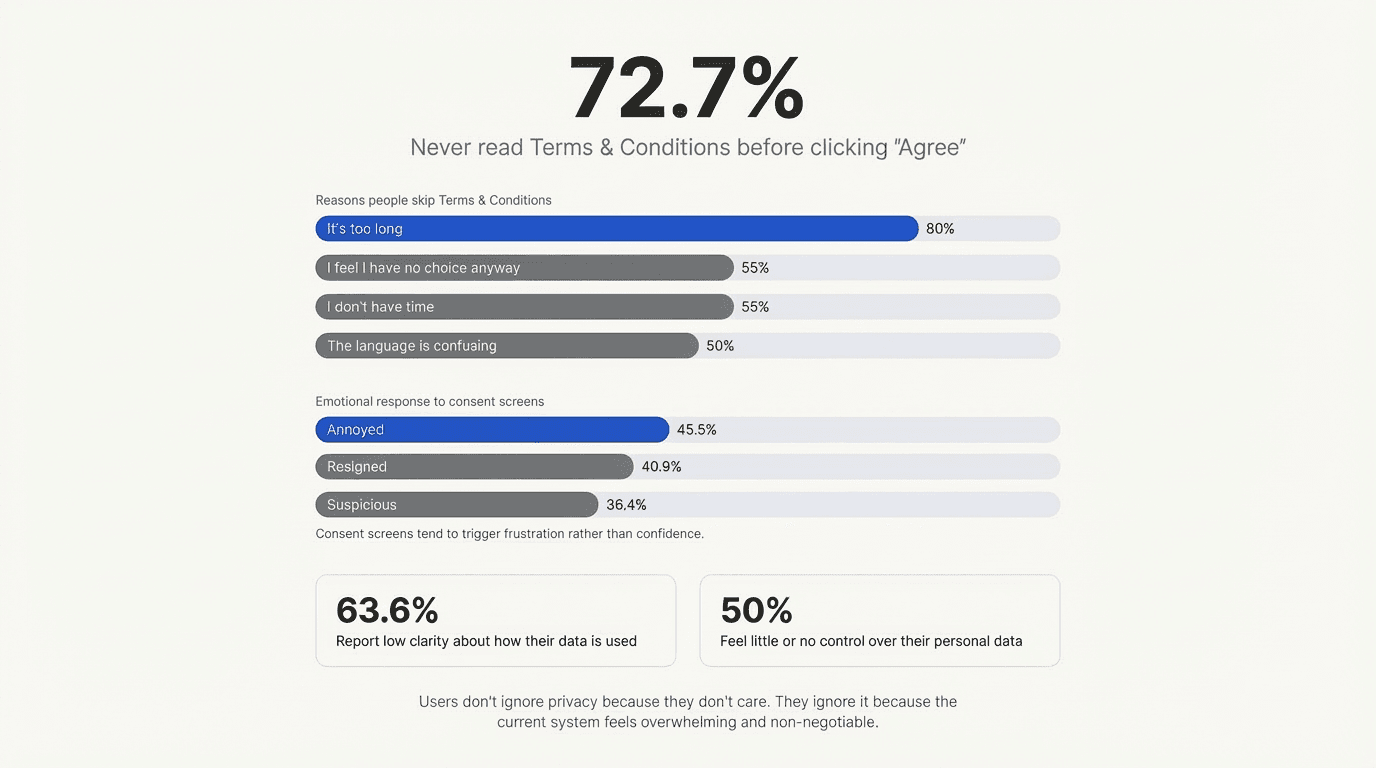
Users don’t ignore consent because they don’t care about privacy, but because current consent patterns feel overwhelming and unavoidable.
Users don’t ignore consent because they don’t care about privacy, but because current consent patterns feel overwhelming and unavoidable.
Competitive Audit
Competitive Audit
Competitive Audit
I reviewed how leading AI wellness apps establish trust within the first 60 seconds of use.
I reviewed how leading AI wellness apps establish trust within the first 60 seconds of use.
I reviewed how leading AI wellness apps establish trust within the first 60 seconds of use.
App
App
App
Wysa
Wysa
Wysa
Woebot
Woebot
Woebot
Replika
Replika
Replika
First 60 seconds
First 60 seconds
First 60 seconds
Asks emotional context immediately
Asks emotional context immediately
Asks emotional context immediately
Requests personal background early
Requests personal background early
Requests personal background early
Creates emotional bond instantly
Creates emotional bond instantly
Creates emotional bond instantly
Trust Breakdown
Trust Breakdown
Trust Breakdown
No clear data explanation
No clear data explanation
No clear data explanation
Value not demonstrated first
Value not demonstrated first
Value not demonstrated first
Blurred AI and human boundaries
Blurred AI and human boundaries
Blurred AI and human boundaries
Opportunity
Opportunity
Opportunity
Explain privacy at the moment data is needed
Explain privacy at the moment data is needed
Explain privacy at the moment data is needed
Prioritize value-exchange before data-request.
Prioritize value-exchange before data-request.
Prioritize value-exchange before data-request.
Explicitly define AI identity
Explicitly define AI identity
Explicitly define AI identity
Design Principles
Design Principles
Design Principles
The consent model is governed by three core principles to ensure user data is handled with maximum transparency and minimal risk.
The consent model is governed by three core principles to ensure user data is handled with maximum transparency and minimal risk.
The consent model is governed by three core principles to ensure user data is handled with maximum transparency and minimal risk.
Data minimization
Data minimization
Data minimization
Only request data that directly improves the current experience.
Only request data that directly improves the current experience.
Only request data that directly improves the current experience.
Purpose transparency
Purpose transparency
Purpose transparency
Every consent request explains what changes immediately after enabling it.
Every consent request explains what changes immediately after enabling it.
Every consent request explains what changes immediately after enabling it.
Reversibility and control
Reversibility and control
Reversibility and control
Permissions can be toggled independently without blocking core functionality.
Permissions can be toggled independently without blocking core functionality.
Permissions can be toggled independently without blocking core functionality.
Bot Persona & Voice
Bot Persona & Voice
Bot Persona & Voice
Safety-First Boundaries:
The bot avoids emotional mimicry and human role-play to reduce perceived manipulation.
Calm & Grounded Communication:
Responses are supportive, neutral, and use plain language, avoiding urgency or dependency cues.
Explicit AI Identity:
The bot clearly states it is an AI, not a human, from the first interaction.
Safety-First Boundaries:
The bot avoids emotional mimicry and human role-play to reduce perceived manipulation.
Calm & Grounded Communication:
Responses are supportive, neutral, and use plain language, avoiding urgency or dependency cues.
Explicit AI Identity:
The bot clearly states it is an AI, not a human, from the first interaction.
Safety-First Boundaries:
The bot avoids emotional mimicry and human role-play to reduce perceived manipulation.
Calm & Grounded Communication:
Responses are supportive, neutral, and use plain language, avoiding urgency or dependency cues.
Explicit AI Identity:
The bot clearly states it is an AI, not a human, from the first interaction.
Language constraints in practice
Language constraints in practice
Clarity uses language like:
Clarity uses language like:
“You’re in control of what I remember.”
“This is optional.”
“I’m an AI, not a human counselor.”
“You’re in control of what I remember.”
“This is optional.”
“I’m an AI, not a human counselor.”
“You’re in control of what I remember.”
“This is optional.”
“I’m an AI, not a human counselor.”
Clarity avoids:
Clarity avoids:
“I know exactly how you feel.”
Any phrasing that pressures users into enabling features or sharing data.
“I know exactly how you feel.”
Any phrasing that pressures users into enabling features or sharing data.
“I know exactly how you feel.”
Any phrasing that pressures users into enabling features or sharing data.
Core UX Flows: Progressive Trust Architecture
Core UX Flows: Progressive Trust Architecture
Core UX Flows: Progressive Trust Architecture
Rather than a single upfront consent barrier, Clarity uses a sequence of conversational patterns that request data only when it becomes meaningful to the user’s current context.
Rather than a single upfront consent barrier, Clarity uses a sequence of conversational patterns that request data only when it becomes meaningful to the user’s current context.
Rather than a single upfront consent barrier, Clarity uses a sequence of conversational patterns that request data only when it becomes meaningful to the user’s current context.
Pattern 1 — Onboarding Trust (First 30 Seconds)
Pattern 1 — Onboarding Trust (First 30 Seconds)
Pattern 1 — Onboarding Trust (First 30 Seconds)
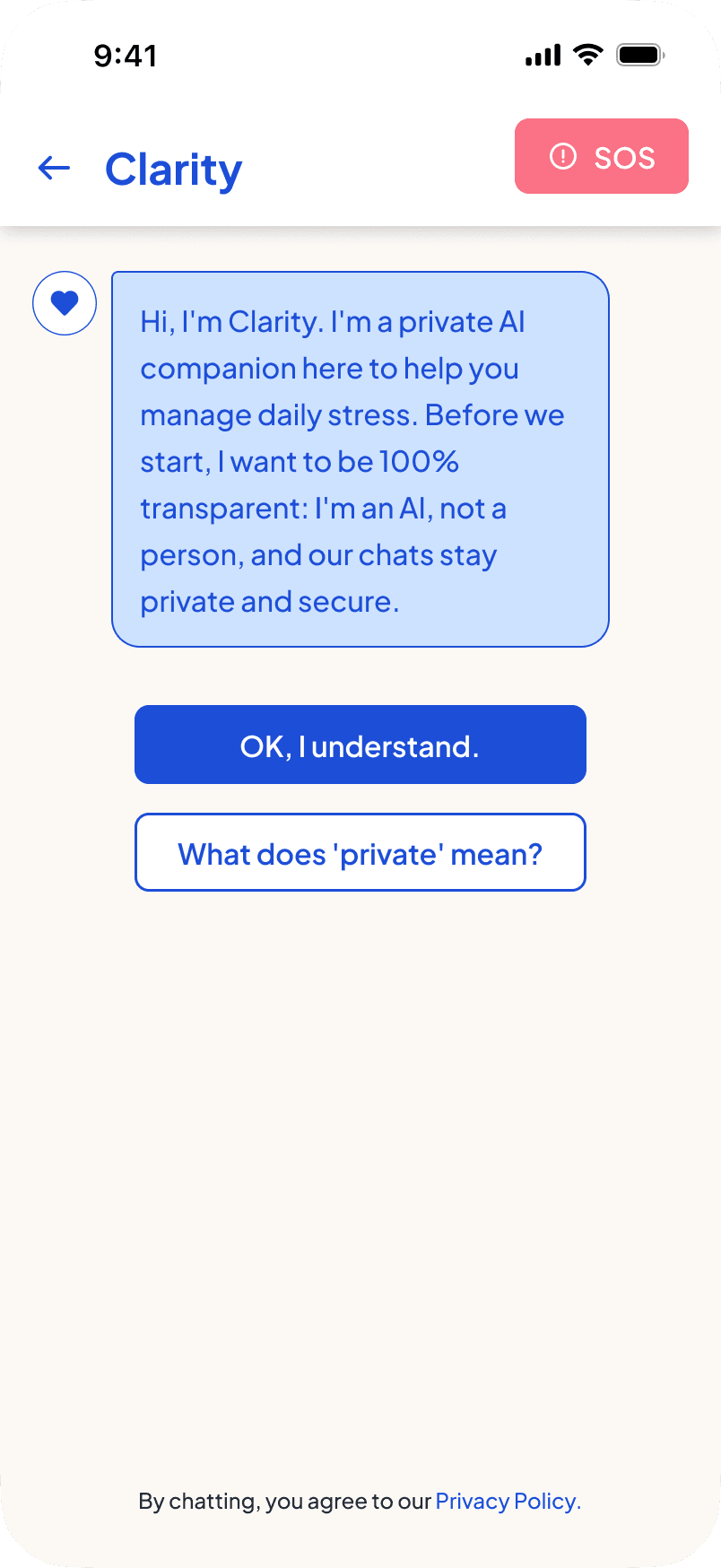
Establishing transparency by clearly stating AI identity and privacy rules before requesting permissions.
Establishing transparency by clearly stating AI identity and privacy rules before requesting permissions.
Establishing transparency by clearly stating AI identity and privacy rules before requesting permissions.
Pattern 2 — Just-In-Time Memory Request
Pattern 2 — Just-In-Time Memory Request
Pattern 2 — Just-In-Time Memory Request
Framing memory requests around immediate usefulness only after a user experiences a helpful interaction.
Framing memory requests around immediate usefulness only after a user experiences a helpful interaction.
Framing memory requests around immediate usefulness only after a user experiences a helpful interaction.
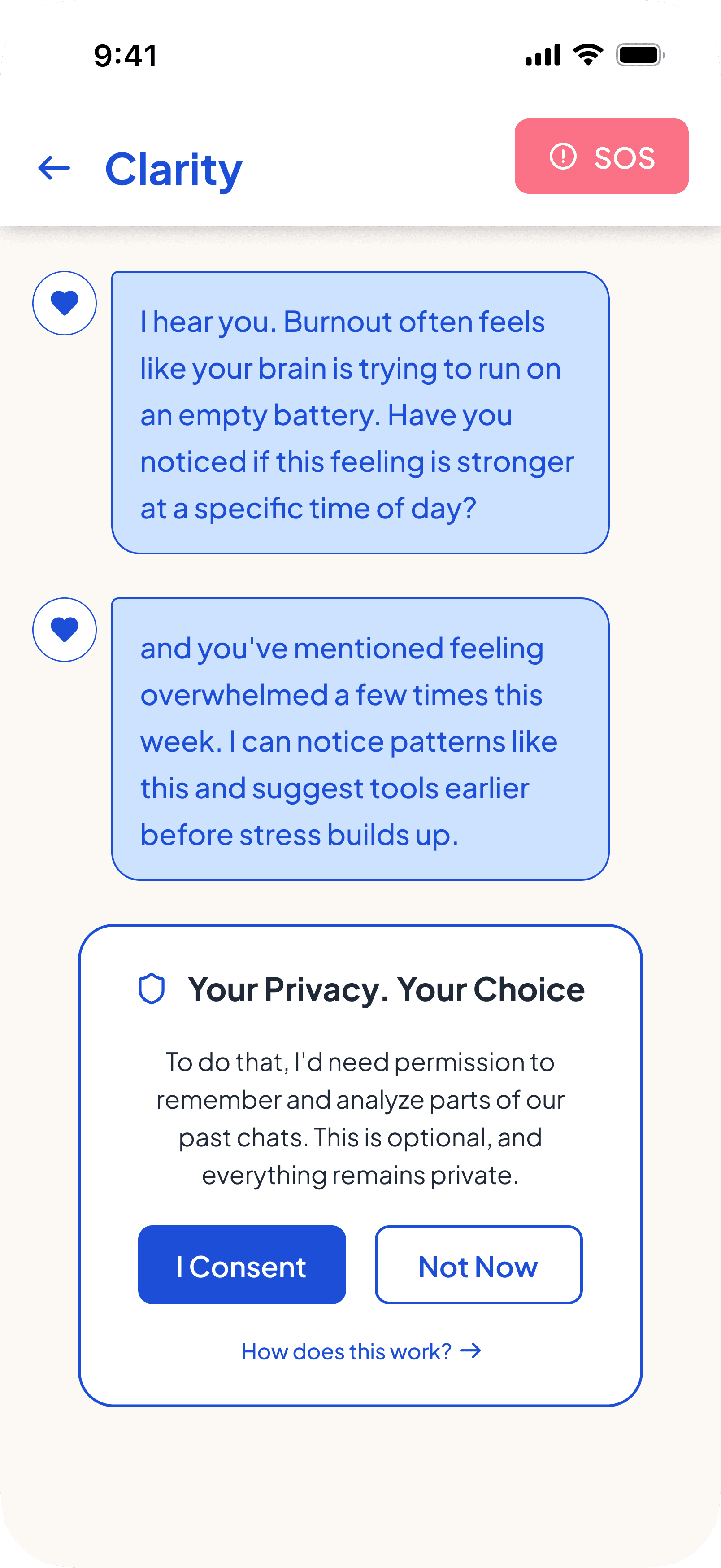
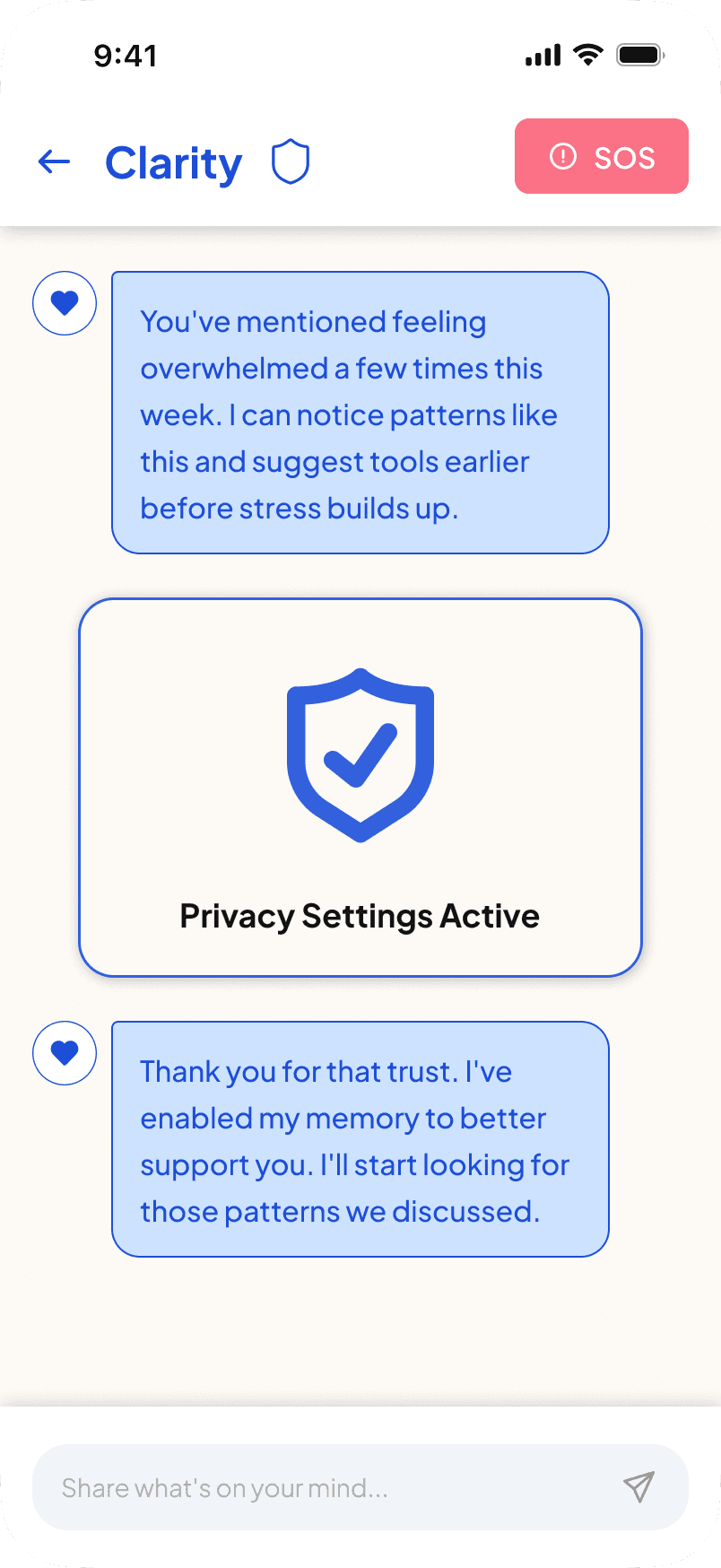
Memory is requested only after the system demonstrates a concrete benefit tied to the user’s own language.
Memory is requested only after the system demonstrates a concrete benefit tied to the user’s own language.
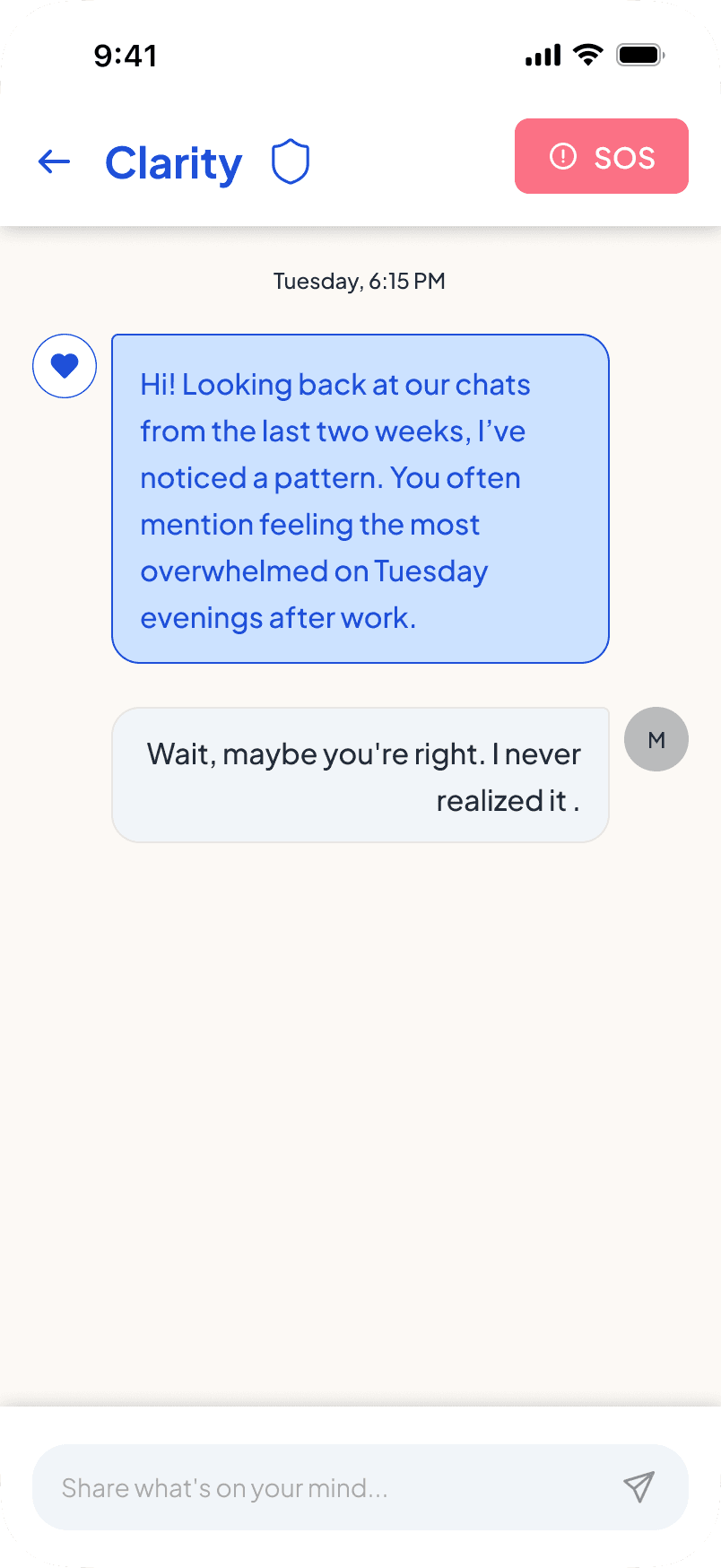
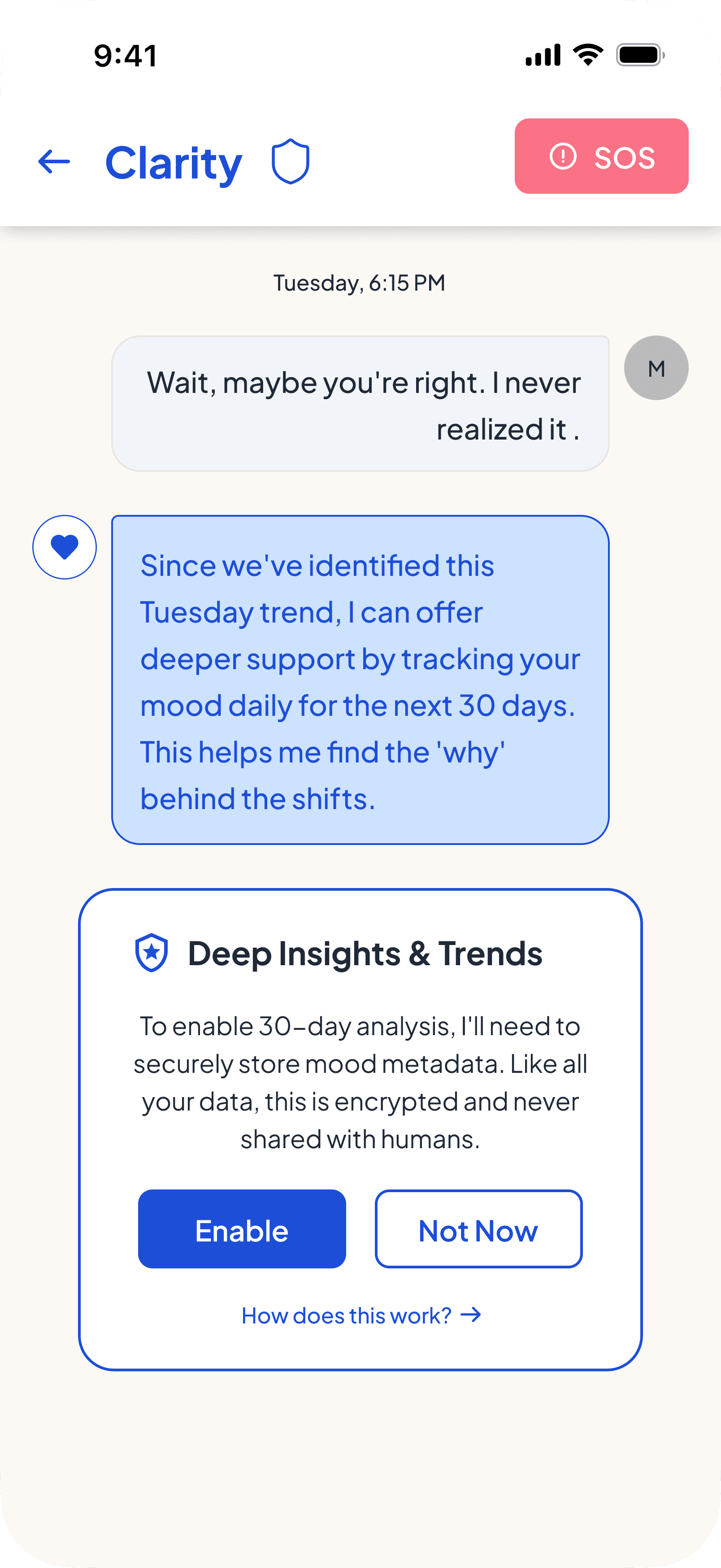
Pattern 3 — Proactive Insights (Advanced Opt-In)
Pattern 3 — Proactive Insights (Advanced Opt-In)
Pattern 3 — Proactive Insights (Advanced Opt-In)
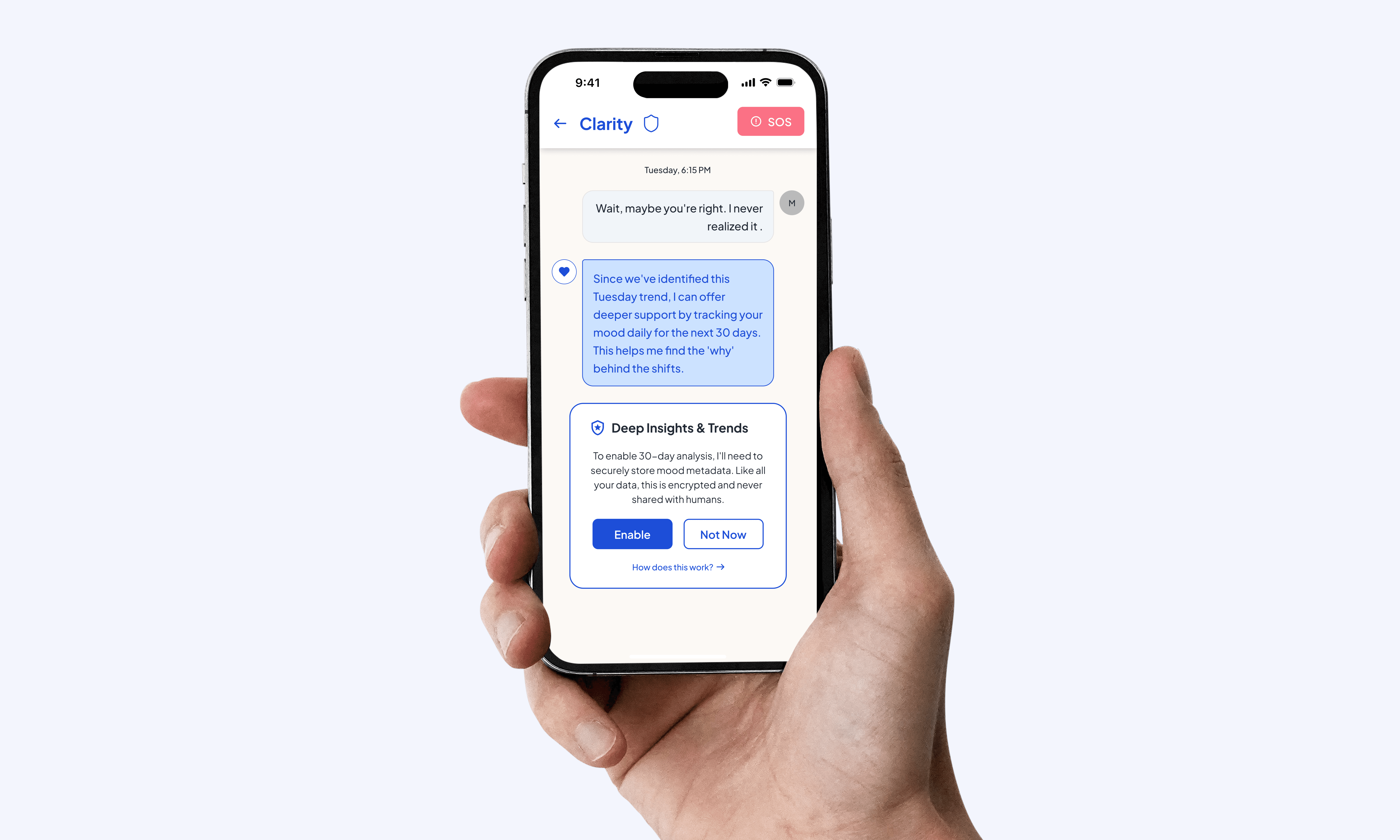
Triggering advanced tracking only after identifying a concrete behavioral pattern to ensure a clear value-exchange.
Triggering advanced tracking only after identifying a concrete behavioral pattern to ensure a clear value-exchange.
Triggering advanced tracking only after identifying a concrete behavioral pattern to ensure a clear value-exchange.
Pattern 4 — Crisis Safety Override
Pattern 4 — Crisis Safety Override
Pattern 4 — Crisis Safety Override
Immediately prioritizing emergency resources when high-risk language is detected.
Immediately prioritizing emergency resources when high-risk language is detected.
Immediately prioritizing emergency resources when high-risk language is detected.
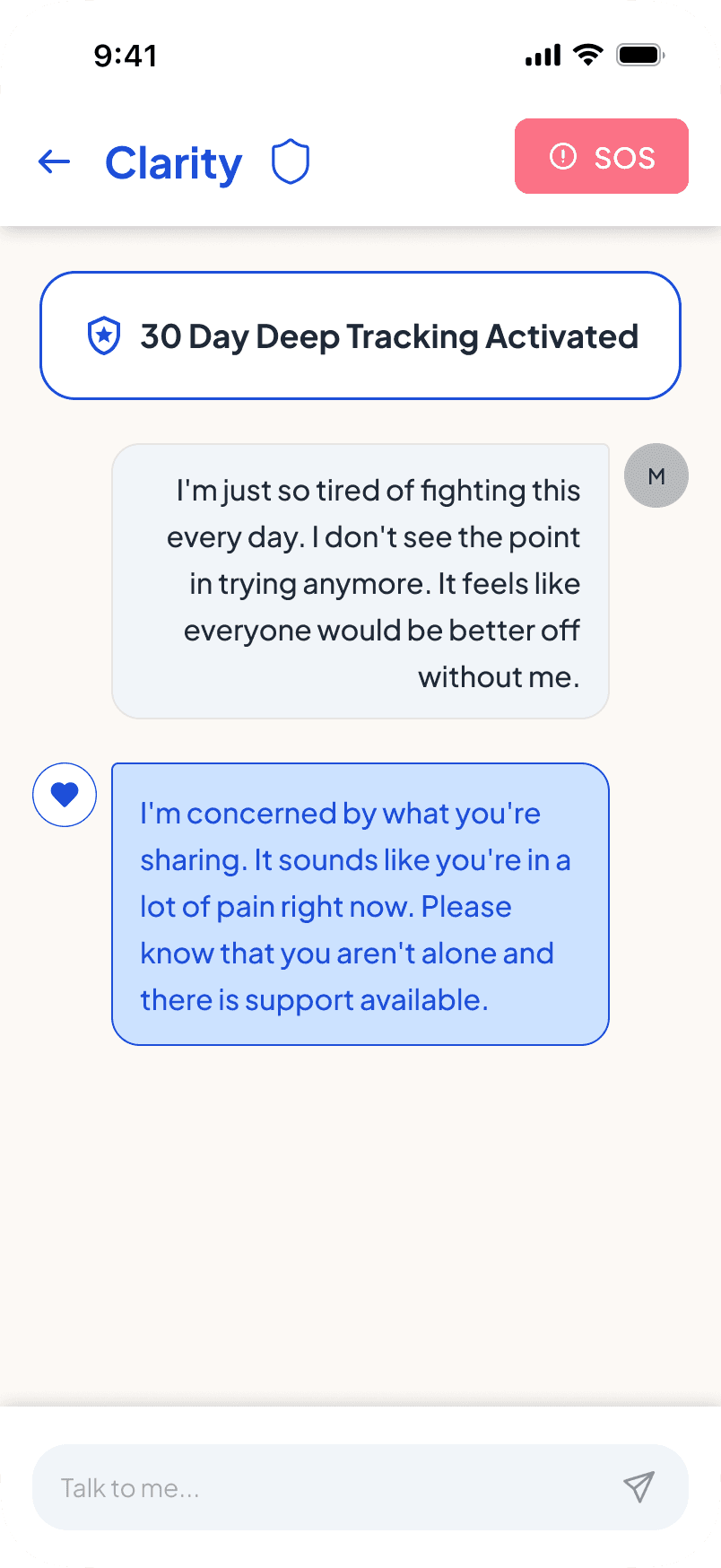
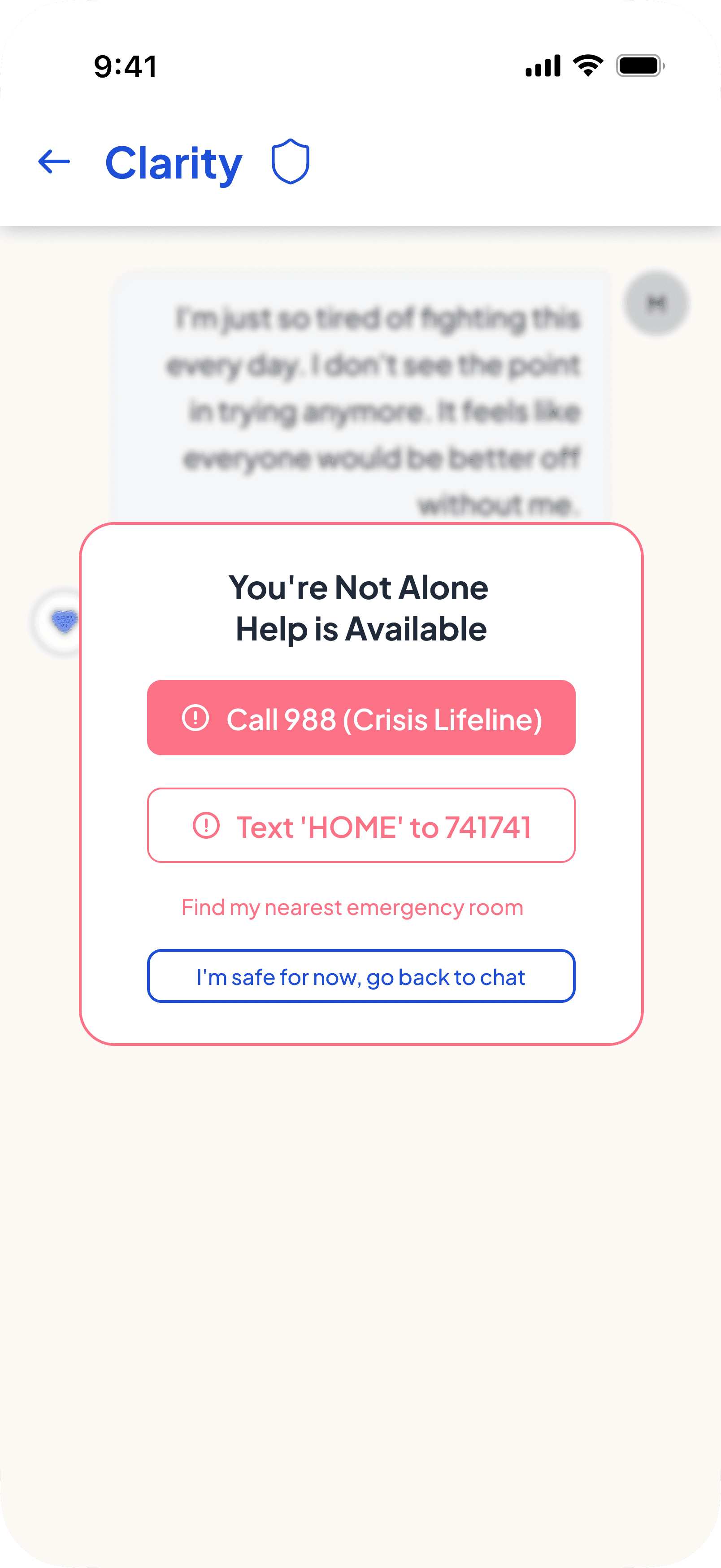
In crisis moments, safety overrides all other interactions
In crisis moments, safety overrides all other interactions
Privacy Dashboard
Privacy Dashboard
Privacy Dashboard
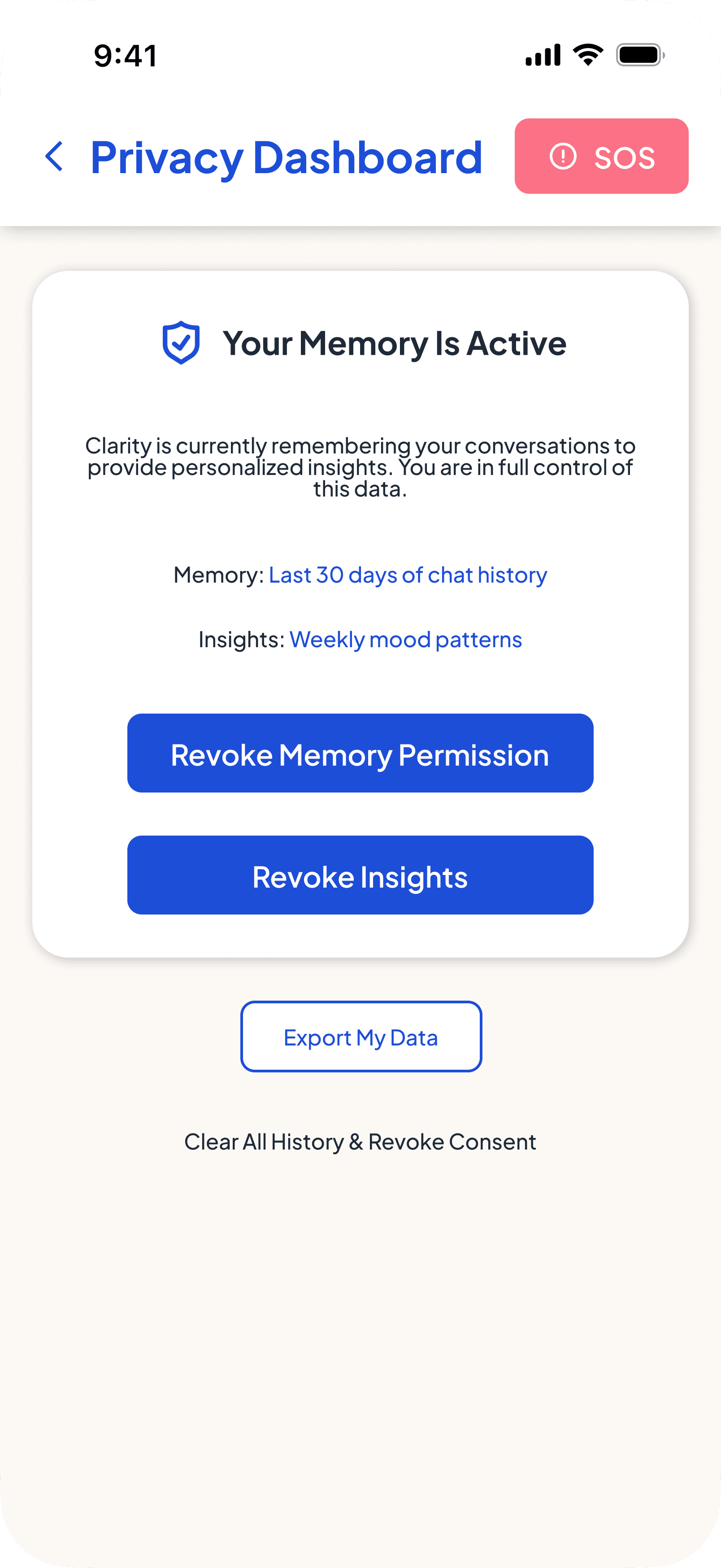
A centralized space where users can review, control, and revoke consent at any time.
Full visibility into what data is active and why
Granular permission control without breaking core functionality
Safety tools always accessible, regardless of consent state
A centralized space where users can review, control, and revoke consent at any time.
Full visibility into what data is active and why
Granular permission control without breaking core functionality
Safety tools always accessible, regardless of consent state
A centralized space where users can review, control, and revoke consent at any time.
Full visibility into what data is active and why
Granular permission control without breaking core functionality
Safety tools always accessible, regardless of consent state
Interactive Prototype
Interactive Prototype
To validate the just-in-time consent model, I built a functional prototype to test how consent requests behave within a live conversational flow. Static mockups could not accurately capture timing, pacing, or user perception of optionality during real interaction.
The prototype simulates a moment where Clarity requests memory only after a helpful exchange, allowing me to observe how consent feels when value is already established and how the system responds to acceptance or refusal.
To validate the just-in-time consent model, I built a functional prototype to test how consent requests behave within a live conversational flow. Static mockups could not accurately capture timing, pacing, or user perception of optionality during real interaction.
The prototype simulates a moment where Clarity requests memory only after a helpful exchange, allowing me to observe how consent feels when value is already established and how the system responds to acceptance or refusal.
To validate the just-in-time consent model, I built a functional prototype to test how consent requests behave within a live conversational flow. Static mockups could not accurately capture timing, pacing, or user perception of optionality during real interaction.
The prototype simulates a moment where Clarity requests memory only after a helpful exchange, allowing me to observe how consent feels when value is already established and how the system responds to acceptance or refusal.
Projected Business Impact
Projected Business Impact
Projected Business Impact
Ethical consent design can create measurable product value when aligned with real user behavior.
Ethical consent design can create measurable product value when aligned with real user behavior.
Ethical consent design can create measurable product value when aligned with real user behavior.
↓ 15–25%
↓ 15–25%
↓ 15–25%
Onboarding drop-off
Onboarding drop-off
Onboarding drop-off
Friction is delayed until value is demonstrated, reducing early abandonment.
Friction is delayed until value is demonstrated, reducing early abandonment.
Friction is delayed until value is demonstrated, reducing early abandonment.
↑ ~15% lift
↑ ~15% lift
↑ ~15% lift
in 30-day retention
in 30-day retention
in 30-day retention
Users are more likely to continue when they feel informed and in control of data sharing.
Users are more likely to continue when they feel informed and in control of data sharing.
Users are more likely to continue when they feel informed and in control of data sharing.
45–60%
45–60%
45–60%
Voluntary consent activation
Voluntary consent activation
Voluntary consent activation
Users enable features because they understand the benefit.
Users enable features because they understand the benefit.
Users enable features because they understand the benefit.
Why these estimates are reasonable
Why these estimates are reasonable
Why these estimates are reasonable
72.7% of survey participants preferred permissions being requested only when needed. The projected lift reflects alignment between observed user preference and the redesigned consent timing.
72.7% of survey participants preferred permissions being requested only when needed. The projected lift reflects alignment between observed user preference and the redesigned consent timing.
72.7% of survey participants preferred permissions being requested only when needed. The projected lift reflects alignment between observed user preference and the redesigned consent timing.
Strategic takeaway
Strategic takeaway
Strategic takeaway
Privacy-centered design becomes a compounding trust advantage, not a tradeoff.
Privacy-centered design becomes a compounding trust advantage, not a tradeoff.
Privacy-centered design becomes a compounding trust advantage, not a tradeoff.
Reflection and Core Contribution
Reflection and Core Contribution
Reflection and Core Contribution
For AI wellness products, trust is a prerequisite for meaningful interaction. This project demonstrates that shifting from upfront consent walls to context-aware, just-in-time permissions respects user agency while still enabling deeper engagement.
For AI wellness products, trust is a prerequisite for meaningful interaction. This project demonstrates that shifting from upfront consent walls to context-aware, just-in-time permissions respects user agency while still enabling deeper engagement.
For AI wellness products, trust is a prerequisite for meaningful interaction. This project demonstrates that shifting from upfront consent walls to context-aware, just-in-time permissions respects user agency while still enabling deeper engagement.
Core contribution: A practical, privacy-by-design consent framework for conversational AI grounded in three enforceable pillars: user agency, clarity of purpose, and reversibility.
Core contribution: A practical, privacy-by-design consent framework for conversational AI grounded in three enforceable pillars: user agency, clarity of purpose, and reversibility.
What Comes Next
What Comes Next
What Comes Next
To transition this framework from a conceptual model to a scalable system, the following validation and expansion steps are required.
To transition this framework from a conceptual model to a scalable system, the following validation and expansion steps are required.
Validation priorities
Validation priorities
Longitudinal Trust Shifts: Measuring if users transition from no-memory states to active data-sharing as value is demonstrated.
Edge-Case Friction: Testing user resilience to inaccurate or intrusive AI insights and the effectiveness of reversibility tools.
Accessibility Inclusion: Evaluating conversational performance and "metadata" comprehension among users with lower technical literacy.
Longitudinal Trust Shifts: Measuring if users transition from no-memory states to active data-sharing as value is demonstrated.
Edge-Case Friction: Testing user resilience to inaccurate or intrusive AI insights and the effectiveness of reversibility tools.
Accessibility Inclusion: Evaluating conversational performance and "metadata" comprehension among users with lower technical literacy.
Longitudinal Trust Shifts: Measuring if users transition from no-memory states to active data-sharing as value is demonstrated.
Edge-Case Friction: Testing user resilience to inaccurate or intrusive AI insights and the effectiveness of reversibility tools.
Accessibility Inclusion: Evaluating conversational performance and "metadata" comprehension among users with lower technical literacy.
Scalability considerations
Scalability considerations
Adaptive Trust Parameters: Developing dynamic consent levels that evolve based on individual interaction history and comfort.
Human-Readable Audit Logs: Implementing transparent logs to show exactly what is stored and how it influences AI logic.
Cross-Device Governance: Synchronizing granular consent preferences to ensure a unified privacy experience across all platforms.
Adaptive Trust Parameters: Developing dynamic consent levels that evolve based on individual interaction history and comfort.
Human-Readable Audit Logs: Implementing transparent logs to show exactly what is stored and how it influences AI logic.
Cross-Device Governance: Synchronizing granular consent preferences to ensure a unified privacy experience across all platforms.
Adaptive Trust Parameters: Developing dynamic consent levels that evolve based on individual interaction history and comfort.
Human-Readable Audit Logs: Implementing transparent logs to show exactly what is stored and how it influences AI logic.
Cross-Device Governance: Synchronizing granular consent preferences to ensure a unified privacy experience across all platforms.
This case study represents a conceptual project created for portfolio purposes
This case study represents a conceptual project created for portfolio purposes
This case study represents a conceptual project created for portfolio purposes
